
Newsletter October/November 2026

October/November 2026
Welcome to our newsletter!
In this issue, we meet Troy Simmons, untangle Radical!'s spaghetti ramps, learn the art of pinball commentary, and see what's new at YOPS.


RADICAL!
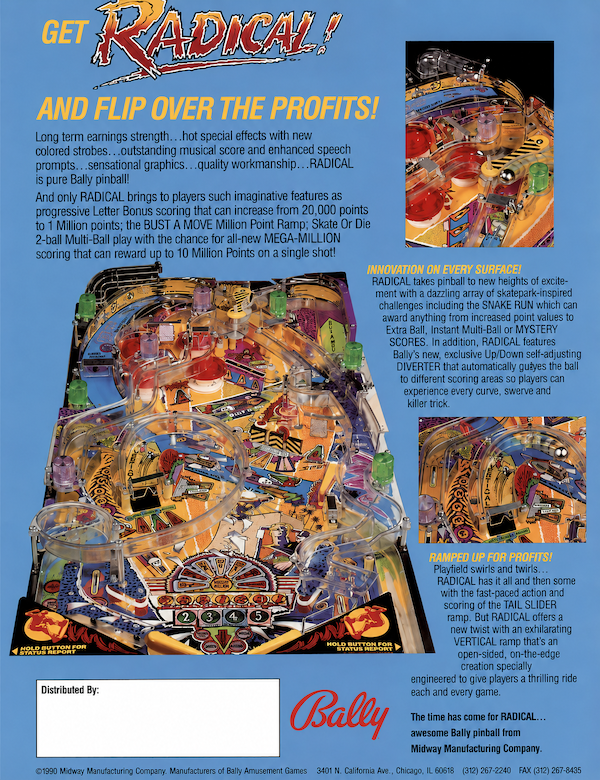
Released at the height of the skateboarding boom, Radical! entered production in June 1990, with roughly 1,300 machines built, making it one of the rarer Bally games from the System 11 era.
It also arrived at an interesting point in pinball history, blending old-school mechanics like physical ball locks with newer ideas such as stackable modes and diverter-equipped ramps.
The backglass artwork was inspired by a January 1990 Thrasher magazine cover featuring skateboarder Steve Caballero, although Bally altered the artwork instead of paying the licensing fee.
The team behind Radical!
Radical! was designed by Dan Langlois and Peter Perry, with artwork by John Youssi and music and sound by Paul Heitsch.
Langlois came to pinball from the arcade game Dark Planet before designing Heavy Metal Meltdown, The Bally Game Show and Radical!. He died in 1991, a year after Radical! was released.
Perry worked on only three Bally games. Youssi later created artwork for many future games, while Heitsch went on to work on Creature from the Black Lagoon and Scared Stiff.
How to Go Radical
RADICAL letters can be awarded through the skill shot and the spot letter target (behind the bottom drop targets) when lit.
RADICAL letters are worth 20K, 40K, 60K, 80K, 100K, 500K, or 1M. Letter values begin at 20K and increase as letters are collected. Each value times out after a few seconds.
Snake Run is lit by completing the three top drop targets.
Tail Sliders is one of Radical!'s signature features. Once it's lit, shots from the upper right flipper can loop back to the left ramp, letting you chain consecutive Tail Sliders together. After the first two, the ball is diverted to the lock lane; then after three consecutive Tail Sliders, then four, and so on. Each loop is accompanied by gnarly music and classic '90s voice callouts.
Unlike many later games, Radical! doesn't have timed combo awards. Instead, ramps, orbits and diverters naturally feed one flipper into the next, making combinations part of the layout rather than a separate scoring feature.
Radical! is often described as a “spaghetti ramps” machine, with plastic ramps crisscrossing the playfield. The shot lines aren't always obvious at first glance, but the layout creates a fast, flowing game with very little stop-and-go play.
SKATE, OR, DIE!


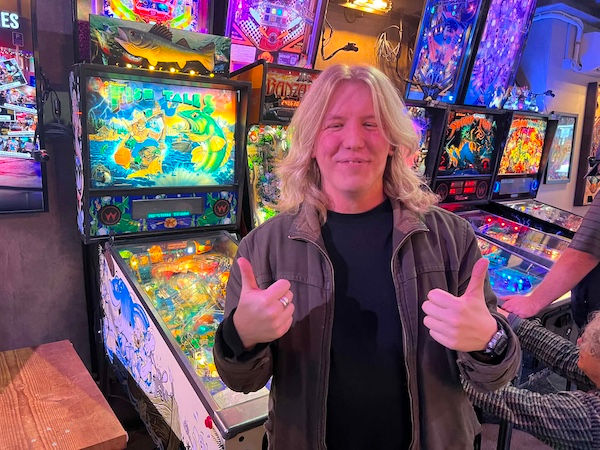
Each issue, we interview a pinball player.
TROY SIMMONS
Kia ora, Troy!
How did you first discover pinball?
Ages ago, when I was younger. We lived on the Kāpiti Coast, and my dad had some arcade machines. At one point we had four: Street Fighter, Mortal Kombat, and one of those 48-game machines with all the classics. I used to beg my dad for a pinball machine. I probably first saw one in a pub.
I discovered pinball as an adult while working at the libraries. Arapaki was just across the road on Manners Street, so I could come into YOPS on a break. I've been saying for years that Timezone sucks. Old arcades are so much better, with actual games, not just gambling for children. The staff are just so lovely. You feel welcome straight away, so it wasn't intimidating.
When you first came here, do you remember any games that you gravitated towards?
Medieval Madness. It's so beautiful in its simplicity. It has that clear objective: just bash the castle.
I was super-casual and really bad, as you are when you start. I like having goals, so reaching 100 million would've had me stoked. Didn't happen.
When I came back, Medieval Madness was still the game I gravitated towards. Happy to say I eventually achieved that goal. Then it was Fish Tales. That's when I really started playing seriously.
Starting work with a new co-worker who'd already been coming here made all the difference. Jordan, who really got me into it, is such a positive person. Having someone there to explain things helped a lot. I never would've figured out Godzilla on my own or worked out how to play it. The staff here are great for that too.
Have you brought in any other people?
Yeah. I just wanted more people to play with. I was raving about this place to my co-workers. I'd say, "Guys, it's so good to switch up your brain." Getting out of the office is important. I don't think I could name any other place where you can do something short, cheap, and that fits into a break.
I'd seen the comps here, so I thought it'd be fun to set up a casual league. Everyone likes a bit of competition, friendly competition.
Did you have a set day and time when you would play?
No. I was encouraging people to go out on breaks at work, so we came up with a different format where we'd pick one machine for the month. You could play any other game, but if you wanted to enter, you'd get your highest score on that machine, take a photo, and upload it.
We use Teams a lot, so I made a Teams chat where everyone chucks their highest score in. If someone beats it, they chuck the new score in. We've got a spreadsheet that tracks them, and the winner picks the next machine. Sometimes I just give them a couple of tokens. I'd love to have something really casual where people could just come down and play.
The fact that you're already doing that is really cool.
Yeah, I think it's a fun, chill format. I like to play is by focusing on one machine.
When I started getting into pinball, that machine was Fish Tales. I really wanted to score a billion, so I was almost exclusively playing Fish Tales. It was really clear-cut; you could see the high scores and learn from them. The billion became my goal because I'd read online that people rate getting a billion on Fish Tales. So I went for it. Ash helped me out a lot with the super jackpots.
What was the last game you guys played casually?
Whenever there's a new machine, I like to jump on that. It was Swords of Fury. Then I think last month was Iron Maiden.
We've gotten really busy at work. I'd still like to organise some socials. I'd like to do something at the end of the month, but I don't want to separate out the top four players. I'd rather have everyone come and play. Maybe it doesn't need much of a format. Maybe it's just a hangout.
I think it's really amazing that you've already taken that initiative.
When we were starting at the big library, the team from Brandon Street came over. We also had people transfer from other libraries, as well as external hires. We were there for two months before it opened, doing pre-opening work. There were a lot of people who needed to get to know each other, so it was the right time for something social.
I probably would have done it anyway because I love pinball and needed an excuse to play it. But it really was the right place, right time. I put up a little poster at work, and I think we've got about twelve people now. It'd be nice to get a couple more, but it's enough.
What has been the hardest thing for you so far?
I can't do drop catches. Can't do it. Trying. One thing I've wondered - and prefacing this by saying I don't want to tell YOPS how to run a business - is it'd be great to have an hour of free play to learn mechanics without pumping money into it. Learning drop catches means I'm going to drain so many balls and spend three tokens practising. Maybe that's just the cost of learning the mechanics.
Live catching is easy. Drop catching - I haven't got it yet. That's my next focus.
What's one piece of advice that another player has given you that's really helped?
I'd say the obvious one is to shoot what's flashing.
Jordan also put me onto the fact that there are rulesets online. They're so helpful for figuring out the progression of a game.
I often read those little cards. Respect to Ash's cards. When I read the manufacturer's cards, my eyes glaze over. It's like, "You hit the doohickey, then smack the whatchamacallit." That's why I prefer reading the online rulesets. I can do it at my desk at work. I feel like watching a YouTube video is pushing it.
Some of those machines have really deep rulesets, and some of the older ones not so much.
The old ones are good. I tried reading the Dune ruleset and thought, 'They're talking about day-night cycles and so much else.' That one I'm just going to feel out.
Is there any machine that you really hate? One that you'd never really want to get into?
I'd say my least favourite is Jurassic Park. That'll probably change in the future. Dracula did my head in, but I ended up having a lot of fun with it. That was the last game where I hit a billion a couple of weeks ago.
I love Labyrinth, the movie. I don't rate the machine at all. It's hard, and the shots don't feel that great to me. There's so much you can do with that film. They've got the two little doors at the top, but then your ball doesn't even go up there. I feel like it's a missed opportunity.
It's a great movie, but the machine's a disappointment. I don't like the idea of releasing a game before it's finished. If I spend twenty thousand dollars on something, there has to be a finished product.
What machine makes you say "Oh, just one more game, just one more game."
It's Fish Tales. That whole mechanic in multiball - locking one ball and flinging another back around - is one of the most satisfying shots in pinball for me. Ash recently put a new wax on Fish Tales, and I've had to relearn the game.
Oh, it's really made that much difference?
It really has. Those angles were locked into my brain.
I think it's awesome spending so much time on one machine, then coming back to it later. I was disappointed in myself that I'd lost it, but you don't really want it to be easy either. It'd be cool to get an even higher score. I think that'll come with mastery. Hopefully it comes back easier.
It's nice to have a target, even though it's not necessary. It gives you what you'd get from a competition, but at your own pace. It's like earning achievements in video games.
If you had to convince a friend in 30 seconds to play pinball, what would you say? What would your pitch be?
The big draw is the physicality of it. If you like video games and want something you can actually feel, pinball gives you that. Most people like bright lights. It's a random comparison, but people go to New York's Times Square and marvel at all the lights around them. Pinball is like that, but condensed into the size of a box. Then you get to interact with it.
I like art that's fun and full of colour. That's why I like graffiti, city art, and things like that. There's a sculpture- I think it's in Leeds Street. It's just a big light bulb, and it lights up. What a good way to do lighting.
Things don't have to be boring.
Is there anything that you'd like to add?
I'd add that when I was working over there five years ago at the library, I think I was having a hard time in my life and needed a distraction. Everything else in my brain turned off for five minutes.
I'm not advocating running away from your problems, but sometimes you want to go somewhere loud and stimulating. Something about it makes it quieter in your brain.
I also want to say thank you to YOPS. Please stay in Wellington, even if you end up moving. Even if you were further away and I couldn't come during my breaks, I'd still make time to come. The location next to the library is just perfect. Not good for my wallet. Good for my mental health.

GAMETOKEN Update
Gametoken is up to the 4th board revision. The NFC board in use is not FCC certified, meaning Gametoken cannot be sold into the US without using a different radio component. The existing NFC boards can still be used at YOPS. We are hard at work designing a new PCB with on-board ESP32 and an FCC certified NFC chip. The protocol design also continues to improve, now supporting gift vouchers with one-time QR codes to be redeemed at the bar. Gametoken will also support preprinted cards for freeplay, which we think will be nicer to use than receipt paper QR codes.
On the Mic - Three Commentators Explain What Makes a Pinball Broadcast Work
A pinball stream already shows the score. It shows every flip, every drain and every celebration. So what exactly is a commentator adding?
Three commentators - Tyler Dipper, Josh and Ashley Burke - were asked the same eight questions about the craft of commentary. Their answers weren't identical.
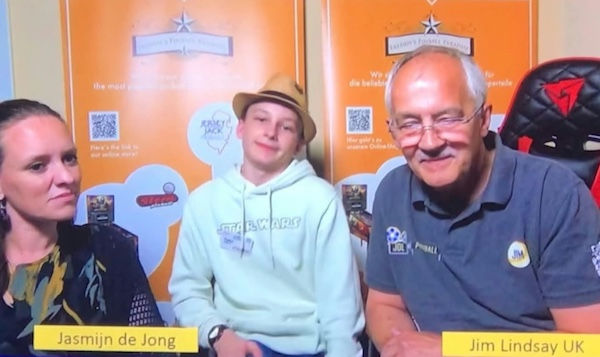
Tyler Dipper (middle) co-commentating as a guest at the 2023 World Championships in Germany, on the JDL Pinball stream.
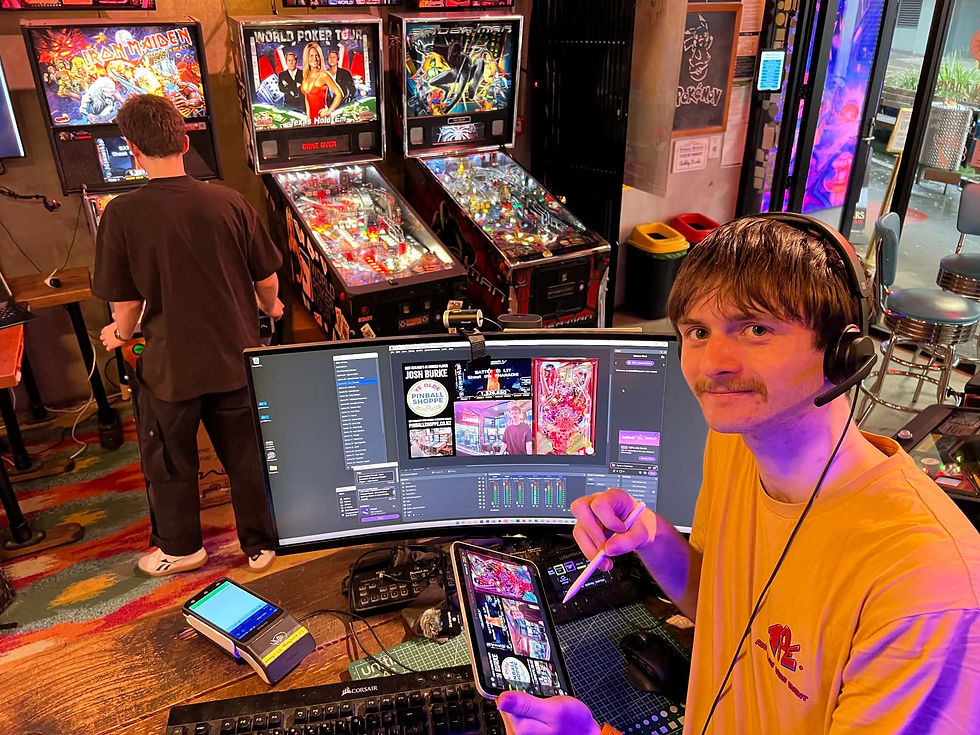
At YOPS- Josh Burke commentating on Ashley's Iron Maiden game.
More than describing what's happening
The first question was simple: what's the role of a pinball commentator? Tyler's answer focused on explaining the game to viewers. It's to give an educational role to the viewers - to tell them what's going on, what is happening, what this person will be doing." For him, commentary means explaining consequences as much as actions. If someone misses a shot, viewers should understand what that changes.
Josh emphasised keeping viewers engaged.
Ashley described commentary as the bridge between gameplay and the audience. "The commentator comes in and adds context and a bit of a story to tell for the person to continue to stay engaged." Although they emphasised different things, none of them described commentary as simply reading out what viewers could already see.
Why game knowledge matters
Every interview came back to game knowledge.
Tyler was direct. "If you don't know how to play the game and you're just commentating on what flipper skills they're doing, you are out of things to talk about within, like, 20 seconds." He remembered commentating on Winchester Mystery House at the Brisbane Masters - a game he'd never played. Rather than pretending to be an expert, he let other commentators explain the rules while he focused on scores, match situations and what players needed to achieve.
Josh said: "Even if they don't [know everything], it's fine. But as long as I see the passion there."
Ashley added a practical distinction: commentators shouldn't assume viewers already understand the playfield, and using the telestrator [drawing on screen] can make it much easier to follow.
Deciding what deserves attention
Knowing the rules isn't the same as explaining all of them.
Josh explains that he usually gives a brief overview at the start of a game before adding more detail as play unfolds, drawing on what he described as "a pretty good grasp of all the rules."
Tyler described almost the same process as a "priority list" - a mental order of the shots and objectives that matter most at any given moment. "A hurry-up starts, then that takes priority." Without understanding those priorities, he argued, commentators can accidentally misread what they're watching.
"There may be a multiball lit, and you keep saying, 'Hit the multiball, hit the multiball, hit the multiball.' But if you don't know what the rules of the game are, you don't understand that they're trying to combine it with a mode and a playfield multiplier."
Ashley pointed to another common mistake. "There are times when people basically just read off the entire rules sheet." Instead, he prefers explaining the shots that matter at that moment so viewers understand the player's objective without hearing every rule in the game.
Don't lose the game
One topic that came up was what commentators deliberately avoid talking about during a broadcast.
"People don't want to hear a whole conversation about your lunch."
For Tyler, that didn't mean stripping personality out of commentary. Mentioning something happening around the venue was fine - as long as the focus quickly returned to the game. Ashley recognised the same idea, saying he'd heard people make similar comments about spending too long talking about the food truck at a venue.
Ashley raised another topic he tries to avoid: talking about a game he's just played in the same tournament. "Especially if it didn't go well." He said there's a difference between using a previous game to explain a machine and dwelling on a loss. As he put it, when commentators "start going on about their previous games, and especially when they didn't go well," it's time to move the focus back to the match on stream.
Josh summed up his reaction with a laugh. "Out of the booth, buddy."
Critiquing without shaming
Tyler argued that when a player makes an unexpected decision, the commentator's job is to explain what they're likely trying to achieve rather than simply asking, "Why are they shooting that?"
Ashley described approaching it differently depending on who was playing. During Multiball Maidens, he said he wouldn't shame anyone. During Pōneke Pinballers finals, he'll joke with players he knows well about missed opportunities but never in a genuinely mean-spirited way.
Why tournament pinball looks easier than it is
All three wanted viewers to understand that tournament pinball isn't the same as casual play.
Josh pointed to machine setup. "Every game's different." Tournament machines play differently enough that viewers often underestimate how difficult they are.
Ashley argued that elite players aren't eliminating randomness. "It's about reducing as much randomness and controlling as much as you can."
Tyler used Star Wars as an example of how differently competition can feel from casual play. During Matariki weekend, he said he "couldn't even put up 200 million" in competition. Later, on the same game at Timezone, he scored 22 billion, adding that he regularly scores billions at home. He compared that pressure to a competitive Rubik's Cube solver who produced a world-record pace during warm-up before performing much slower once the official attempt began.
Why two commentators often work better than one
None of the three preferred working alone.
Josh liked the back-and-forth. "They can riff off each other." He remembered streaming John Wick in Australia with another commentator who knew the rules inside and out while Josh asked the questions viewers were likely wondering themselves.
Ashley compared that relationship to early Rick and Morty. One person asks the obvious questions. The other answers them.
Tyler described something similar happening during Jurassic Park at Brisbane Masters. He explained the rules. The game's owner explained how that particular machine actually played.
Commentary changes the commentator too
Commentary doesn't just help viewers understand pinball. It changes the commentator's understanding too.
Ashley compared it to writing an essay. Explaining something clearly forces you to understand it more deeply.
Josh described learning from watching other players. "You genuinely play like who you watch."
Ashley laughed that he'd started attempting tap passes after watching enough streams - even though they weren't working yet.
Tyler changed his own Godzilla strategy after noticing elite players repeatedly choosing Megalon.
Keeping viewers invested
The interviews eventually widened beyond commentary itself and into streaming.
Josh described the mental shift between competing and commentating. "It's always hard to play and talk."
Ashley said broadcasts work best when they give viewers someone to invest in, pointing to finals where an underdog story helps people understand what's at stake.
The conversation turned to the YOPS Twitch stream, Open Broadcasting Software, archiving tournaments and encouraging more people to try commentating. One production idea was a dedicated commentator camera, so viewers can see who's speaking as the conversation unfolds.
A common thread was making broadcasts easier to follow. Whether through clearer explanations, telestration or better stream layouts, each described ways to help viewers follow the game.
What they hope viewers take away
The final question was what they hoped someone would leave with after watching a broadcast.
For Josh, the ideal reaction was watching a stream, wanting to play that game immediately, and trying what he'd just learned.
Tyler hoped every broadcast taught something - whether that was a new strategy for someone watching live or a lesson for the player watching their own game back.
Ashley hoped viewers would become invested in the tournament - following the players, understanding the format, and wanting to see who came out on top.
Give it a go
YOPS tournaments are streamed live on the Pinball Shop Twitch channel, and the team is keen to keep growing the commentary side of the community.
Feel like giving commentary a go? Chat to Hamish or Ashley at the next tournament - they'd love to get more people involved.

Strategy to progress through and score on Radical!
Like a lot of pinball machines from this era, the main objective in Radical! is simple: start multiball and collect the jackpot.
But getting there takes a few steps.
Collecting R-A-D-I-C-A-L
Scattered around the playfield are the seven letters that spell R-A-D-I-C-A-L.
Each letter is collected by making a specific shot:
R: Snake Lane
A: Vertical Ramp
D: Top Spinner / Left Orbit
I: Right Ramp
C: Bottom Drop Targets
A: Left Ramp
L: Right Spinner / Right Orbit
You can also collect letters by "shatzing" the inlanes. This is a technique where you wait until the ball reaches the very end of the flipper, then alley-pass it across and up the opposite inlane.
With our YOPS copy we have the tournament ROM so shatzing only works to progress your first Multiball, so take advantage of it early!
Completing R-A-D-I-C-A-L awards several things:
Lights the Kickback, which saves the ball from the left outlane.
Lights the Million shot at the "C" target for a few seconds.
Starts SKATE OR DIE.
Skate or Die (Locks)
Once SKATE OR DIE begins, your objective is to lock a ball.
Three shots that can be used to lock it:
Snake Lane
Left Ramp
Right Ramp
After locking your first ball, you'll need to collect all seven R-A-D-I-C-A-L letters again. This time, the letters must be collected individually.
Complete them all to light the second lock, then lock your second ball to start Multiball.
Multiball & Mega Millions
Radical! features a two-ball multiball.
Once Multiball begins, Mega Millions, the game's jackpot, is lit at the Left Ramp.
Don't panic if you lose one of the balls! Mega Millions remains lit for a short time after Multiball ends, giving you one last chance to collect it.
Again, the tournament ROM keeps the Mega Millions value consistent:
First Mega Millions: 4,000,000 points
Second Mega Millions: 6,000,000 points
After collecting your first Mega Millions, the process begins again. You'll need to complete R-A-D-I-C-A-L, then lock both balls within a short time of each other to start another Multiball and go for the bigger jackpot.
QUICK Million
There are 2 instant Million shots on the playfield:
The side ramp and the target behind the front drop targets. Both will award you a nice easy million when lit.
INCOMING GAMES
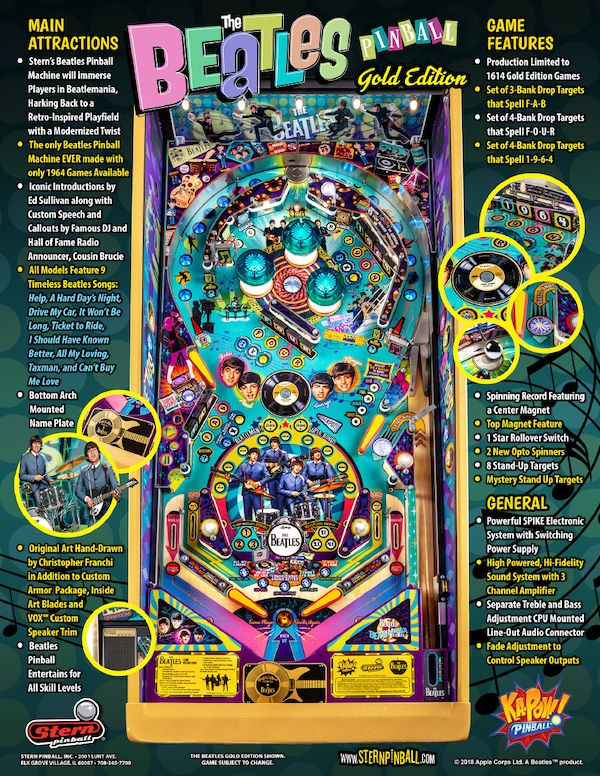
The Beatles Pinball- Gold Edition now at YOPS!
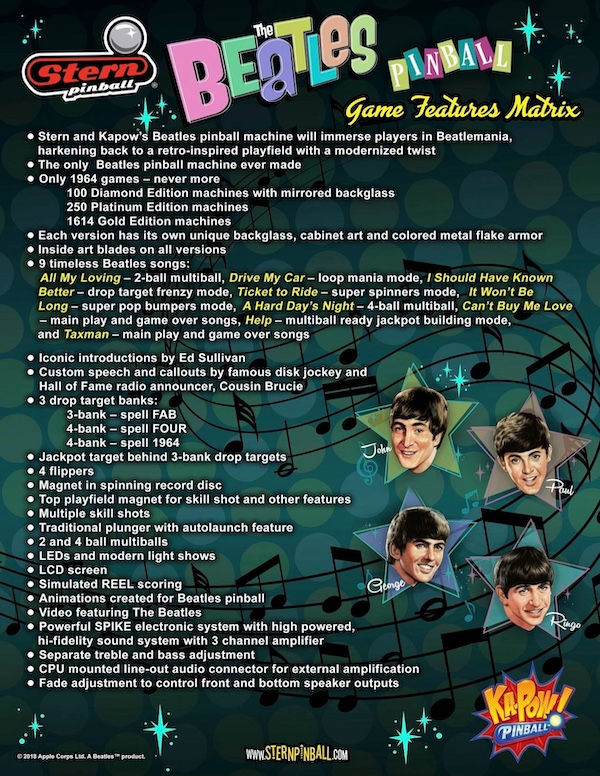
The newest arrival at YOPS is The Beatles Pinball Gold Edition. It's one of just 1,964 machines produced across the Diamond, Platinum and Gold editions, a nod to the band's landmark year in 1964. Fun fact: they actually stayed just around the corner at Wellington's St George Hotel when they performed that year! If you go into the foyer, you can still see the original newspaper photo.
The game features nine Beatles tracks, a spinning centre record with a magnetic ball lock, drop-target banks spelling FAB, FOUR and 1964, and two-ball and four-ball multiball modes. It also features Ed Sullivan introductions and custom speech callouts by Hall of Fame radio announcer Cousin Brucie.

Beetlejuice
Is on the way!


Check out these videos to learn more about Beetlejuice
Stay in the Loop with YOPS
Get updates on new machines, tournaments, arcade news, special events and exclusive offers.
Christmas party season has arrived!
Your work Christmas party has one guaranteed outcome.
Someone's going to become weirdly competitive.
Book the team into Ye Olde Pinball Shoppe for craft beer, unlimited pinball and bragging rights that'll somehow still be getting mentioned next Christmas.


Comments